Swimming Pools · 15 March 2025
How to Choose the Right Acrylic Panel Thickness for Your Swimming Pool
Panel thickness is the single most important specification in an acrylic pool project. Too thin and you risk deflection under water pressure; too thick and costs escalate unnecessarily. Here is how engineers and architects approach it.
When clients ask us how thick their pool panel needs to be, the honest answer is: it depends on the depth of water behind it, the width of the opening, and whether the panel is a straight flat sheet or a curved one. There is no single figure that covers every application.
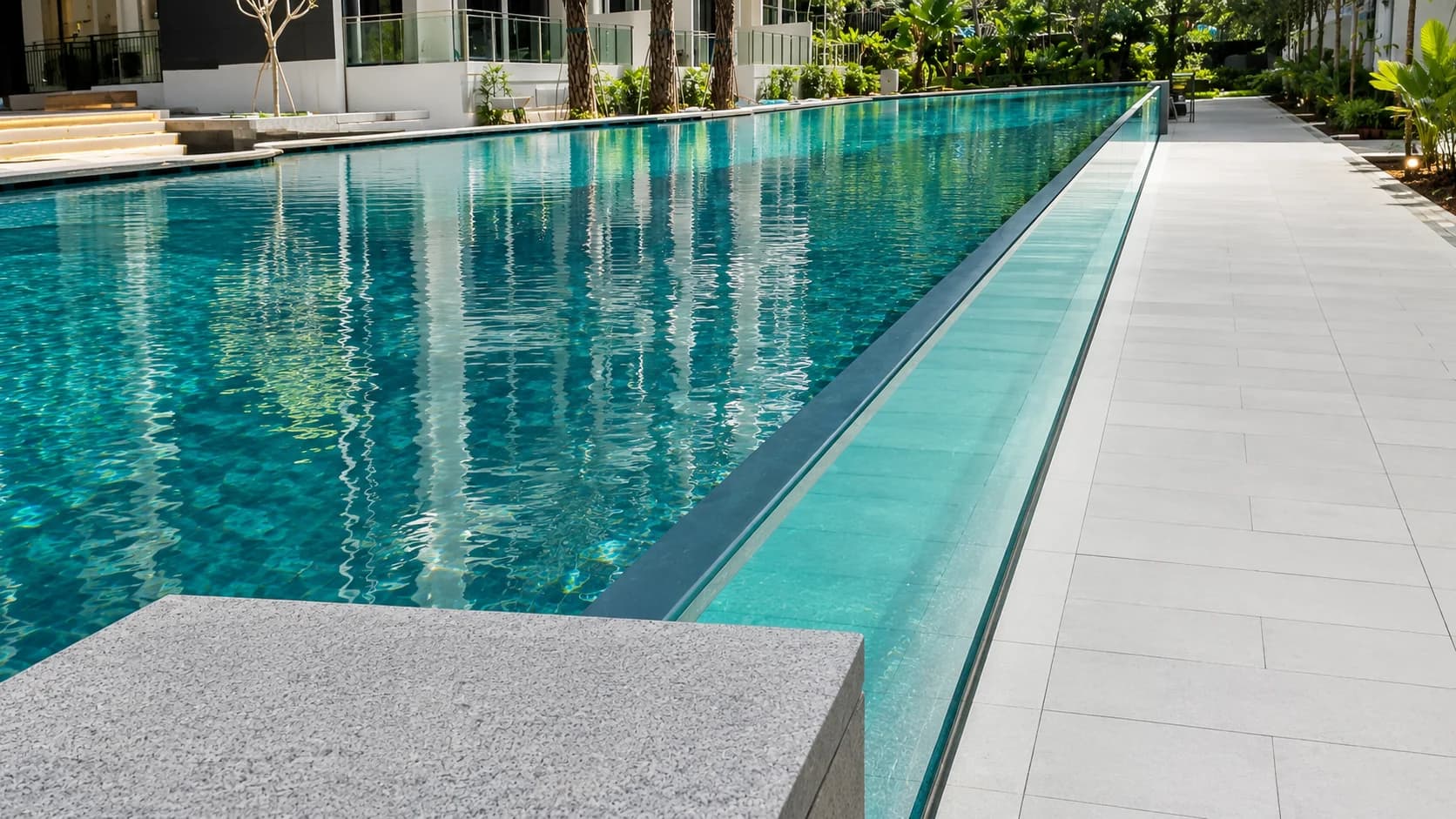
For residential infinity pools with a viewing panel up to 800mm deep, a 60mm to 80mm panel is a common starting point. For deeper pools, hotel features, or large commercial aquariums, panels of 100mm to 150mm or more are the norm. Curved panels, which are thermoformed to shape, typically require additional thickness because the forming process introduces stress that reduces effective load-bearing capacity compared to a flat sheet of the same nominal thickness.
The governing calculation is not complicated in principle: it balances hydrostatic pressure at maximum water depth against the allowable stress for the acrylic grade being used, with a safety factor applied. What makes it complex in practice is that acrylic panels behave differently from glass or steel under sustained load. PMMA is subject to creep, meaning it deflects slowly over time under constant stress. A panel that is perfectly rigid on day one can show visible bow over years if it has been undersized. This is why we recommend working with a Professional Engineer on any pool panel deeper than 1.2 metres, and why Worldbizz provides PE-stamped structural calculations for all commercial projects.
The other factor often overlooked is the support structure. Even a correctly sized panel will deflect excessively if it is poorly supported at its perimeter. The interface between the acrylic and the pool shell, the bedding material, and the sealant all affect how loads transfer. Our installation team reviews the structural drawings before any panel is fabricated, because changing a panel size after fabrication is expensive; changing the support detail is not.
If you are in the design stage of a pool project with a viewing panel, bring us in early. A brief consultation on the structural requirements costs nothing and can save significant rework downstream.
Written by
Worldbizz Engineering Team